
Family Crest Rings: From Coat of Arms to Custom Signet
What a Family Crest Ring Really Is
Let's clear up the vocabulary first, because it saves you trouble later. In heraldry, a "coat of arms" is the whole design, with the shield at the center. The "crest" is technically just the figure that sits on top of the helmet above the shield: a lion, a hand holding a sword, a bird with its wings half open. Most of us say "family crest" for all of it. The coat of arms and the crest each have their own Wikipedia entry if you want the full anatomy.
So a family crest ring is a signet ring carrying some part of that heraldic identity. It might be the crest figure alone, the shield, a monogram built from the family initials, or a simplified version of the whole achievement. A signet is the right vehicle for it. Signet rings began as working tools: the face was cut in reverse so it could be pressed into wax or clay as a personal mark. The history of the signet ring runs back thousands of years, and heraldic devices joined it in medieval Europe, when arms were a visual signature on seals and documents.
One honest caveat. Crest Signet Rings laser-engraves its faces. That's a shallow cut, so these rings are for wearing and not for pressing sealing wax. If you want a ring that works as a functioning seal, that's a different object. If you want a piece of family identity in gold that you'll actually put on every morning, this is exactly the right one.
Why does it matter to people? Usually because the ring carries a story. A grandfather's arms that nobody has worn in forty years. A surname that finally has an object attached to it. A gift for a graduation or a wedding where the family is the point. You can browse the full range of signet rings to see how those ideas translate into actual faces.
Choosing the Right Family Crest Ring
Start with the source artwork
Everything downstream depends on what you have to work from. The best starting point is a clear, high-resolution image of the arms or crest: a scan of a certificate, a page from a family history book, a bookplate, an old letterhead. Phone photos of a framed print taken at an angle are the usual trouble. Glare and distortion hide the fine lines, and fine lines are the whole job.
If you don't have anything, don't panic. Plenty of people only know that "the family had a crest" without ever seeing it. Be careful here, though. A surname shared with a famous coat of arms doesn't automatically mean your branch of the family bore it. Heraldry was granted to individuals and their descendants, not to everyone with the same name. Rules about who may bear or use arms differ from country to country, so if the question matters to you, check with the relevant heraldic authority in the place the arms came from before you commission anything. If your family history is murky, a monogram or initials ring is a perfectly honest alternative.
Decide what actually goes on the face
A coat of arms can have a shield, a helmet, mantling (the decorative cloth flowing off the helmet), a crest, supporters on each side and a motto scroll. On a ring face that's maybe 14 mm tall, you can't fit all of it and expect it to read. Pick the hero element. Usually that's one of these:
- The crest figure on its own (an eagle, a stag, a tower)
- The shield with its charges, simplified
- A monogram or initials, with or without a small heraldic detail
- A single emblem pulled from the arms, such as a rose, a lion or a star
That choice also tells you which face shape to use, which brings us to the next section. Before that, a short note on hands: if you're unsure which finger to wear it on, our guide to which hand and finger is traditionally correct covers it. The short version is the little finger of the hand you don't write with, though the ring finger is also traditional and the index finger is common today.
Top Styles and Shapes
The face shape isn't decoration. It decides how much room your artwork gets and which way the eye travels across it. Here's how Crest's own shapes line up with the common heraldic jobs.
Oval for a classic crest
The Bequest is the classic oval, and it's built for a crest. A tall figure like a rampant lion or an upright bird fits an oval naturally, because the shape follows the vertical line of the subject. If you picture a traditional gentleman's signet, you're picturing an oval.
Square faces for a full coat of arms
A shield with a chevron, a bend or three charges can read clearly on the square face of The Accord or the soft square of The Abbey. Keep the shield outline distinct and leave space around the charges. If the full arms feel crowded, choose the crest figure for the classic oval of The Bequest.
Hexagon for a single emblem
The Bastion is a hexagon, made for an emblem. Think of a single device: a tower, a sword, a fleur-de-lis. The angular outline gives a compact symbol a bit of structure and a modern edge without losing the traditional feel.
Square and soft square
The Accord is a true square and The Abbey is a soft square. Both give you even space on all sides, which suits designs that are roughly as wide as they are tall: a badge, a circular device, a block monogram. The Abbey's softened corners feel a little gentler on the hand.
Other faces worth a look
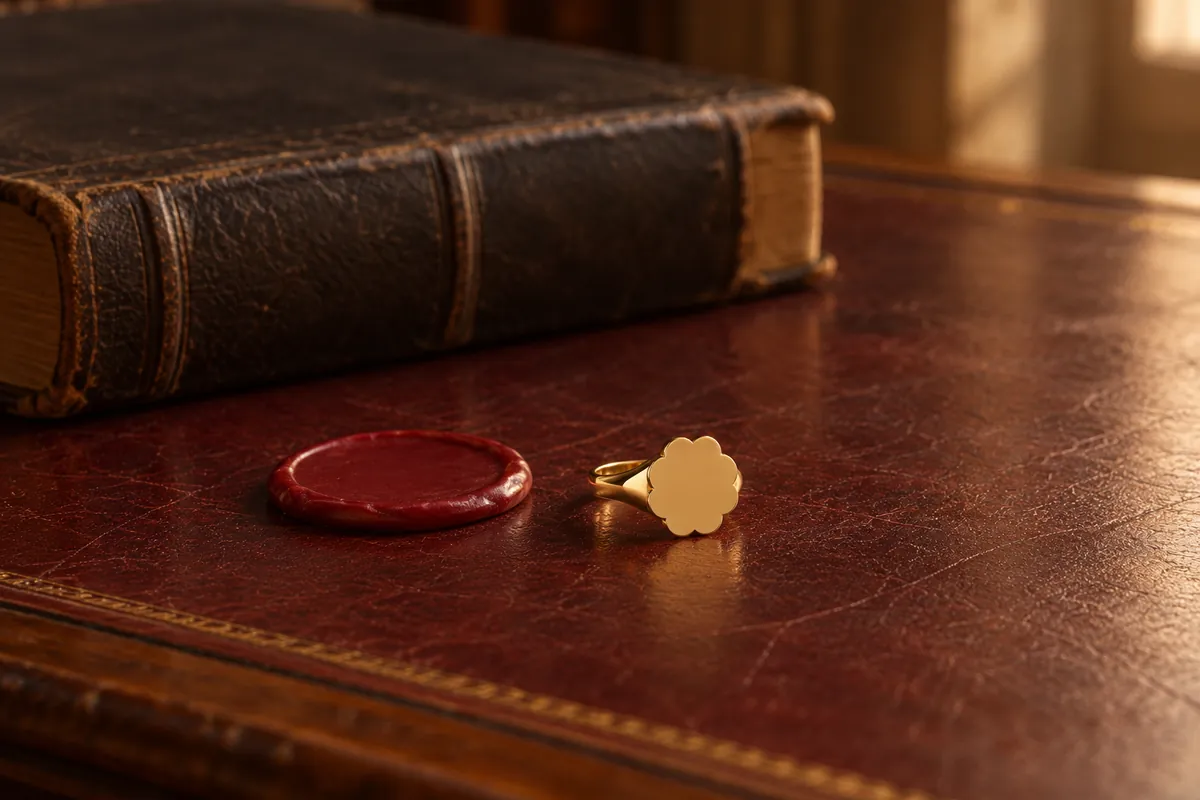
Crest also makes a concave rectangle (The Chancery) and an octagon (The Keep), both intended for initials, plus a cushion shape (The Bower) and a four-leaf clover face (The Clover). If your family device is botanical, consider how its outline would sit within The Clover's four leaves. Browse them all on the main signet rings page.
Gold color
Color changes how an engraving reads. Warmer tones soften contrast a little, which some people prefer for detailed heraldry. If you lean toward a pinker tone, have a look at the rose gold signet rings. Check each product page for the options currently offered rather than relying on a blog post for specifics.
What to Consider Before You Buy
Detail versus legibility
This is where most disappointment comes from. Heraldic art is drawn to be seen on a banner or a wall. Shrink it to ring size and every thin line, tiny hatching pattern and small scroll of text is competing for a few square millimeters. A shallow laser cut is crisp, but it can't make a 0.1 mm line readable. Simplify. Cut the motto. Drop the mantling. Thicken the strokes. A simplified crest that reads clearly beats a faithful one that turns into a smudge of texture.
Blazon, the formal language of heraldry, is useful here. If you have the written description of your arms, you can work out which elements are essential and which are ornament. There's a good outline of blazon on Wikipedia if the vocabulary is new to you.
Sizing, and why it's the part you can't undo
Nothing is cast until you approve your proof, and once you do, the ring is final sale, including the size. So get the size right before you click approve. Crest sizes run from US 5 to US 13.5. A few rules that actually work:
- Measure the exact finger you'll wear it on, not the one you assume.
- Measure at the end of the day, when your hands are warm and at their largest.
- A signet sits best a little snug, because the heavier face tends to rotate on a loose band.
- Between sizes, choose the larger one.
Little fingers are usually smaller than ring fingers, and the knuckle matters: the ring has to get over it. Check the FAQ page if you're unsure about any of this.
The Register number
Each ring has a Register number laser-engraved inside the band. It's a small touch, but it means your ring is identified as its own piece. You can read more about how that works on The Register page.
Warranty and aftercare
Faults are covered by warranty. Ordinary wear isn't a fault, and a gold signet will pick up fine scratches on the face over the years, which is part of its character. Cleaning and storage are simple, and the care guide walks through them. For anything about shipping or returns, see the shipping page on the site, and note that return postage is paid by the customer.
Tips from the Experts
These come from how engraved signets work in practice, not from any one buyer's story.
Reduce before you send. Take your artwork and shrink it on screen to the size of a postage stamp, then to a thumbnail. Whatever disappears at thumbnail size will disappear in gold. Cut it yourself before the proof does.
Respect the face shape. A tall crest in a wide square wastes space and leaves the engraving floating. A wide shield in a narrow oval gets squeezed. Let the subject choose the shape, not the other way around.
Consider initials instead of the full crest. A monogram is easier to engrave sharply, and it avoids any question about whether the arms are really yours. A tight pair or trio of letters on a concave rectangle or octagon is about as classic as it gets. Many families put the crest on one ring and initials on another, which is a tidy way to handle a gift for two generations.
Read the proof slowly. Check spelling, letter order, which way a lion faces, and any detail that carries meaning. In heraldry, left and right are described from the point of view of the person holding the shield, so "dexter" is the viewer's left. If the proof looks flipped, ask. Don't approve until it's right.
Plan for wear. The face of a signet is the first thing to knock against doorframes and desks. That's normal. Worn gently, it softens in an attractive way. If you want it crisp for years, treat it like a good pen and not a work tool.
For more reading on signets, the journal has related guides, and the Crest Signet Rings home page shows the whole offer. A short look at heraldry as a whole can also help you read your own family's arms with more confidence.
Frequently Asked Questions
What is the best family crest ring?
The best one is the one where the face shape suits the artwork. A tall crest figure suits the oval face of The Bequest, a shield can sit well on the square face of The Accord or soft square of The Abbey, and a single emblem suits the hexagonal face of The Bastion. Simple, bold engraving that reads at ring size will always beat a crowded one.
How do I know which ring is right for me?
Start with what you want on the face: a crest, a shield, an emblem or initials. Then match the shape to it, and choose the finger you'll wear it on so you can size accurately. If your family arms are uncertain, a monogram is a clean option that doesn't depend on research.
What should I look for when buying one?
Look for a clear proof process, sizing guidance and honest information about what the engraving can and can't do. Crest faces are laser-engraved in a shallow cut, so they suit wearing and not pressing wax. Also check the warranty and the care advice before you commit.
What happens once I approve my proof?
Only then is your ring cast, because nothing is made before approval. From that point the ring is final sale, including the size, so check the artwork, spelling and size first. Faults are still covered by warranty, and your ring gets its own Register number inside the band.
References & Sources
Every signet is made to order, and nothing is cast until you approve your proof.
See the signet rings